


1/1/2026
Digital Health for MSK: Why the Surgery Avoidance Story Is Bigger Than Pain Reduction
Thirty-six percent of musculoskeletal surgeries performed in the United States are unnecessary. The back surgery failure rate runs between 40 and 46 percent. These are not fringe statistics. They are the financial foundation of the MSK cost problem, and most benefits strategies are not designed to address either one.
The conversation around digital MSK programs has been dominated by pain scores. Members report less pain, functional movement improves, satisfaction is high. Those outcomes are real and they matter clinically. But they are not the ROI story that belongs in a CFO conversation.
The ROI story is surgery avoidance. And that story is significantly larger than most benefits leaders have been told.
The actual cost driver is not pain. It is the operating room.
Musculoskeletal disorders represent one of the largest cost categories in employer health plan spend, accounting for more than $213 billion in annual U.S. healthcare expenditure. That figure is not driven by physical therapy claims or outpatient visits. It is driven by surgical intervention, the post-surgical care that follows, the rehabilitation that may or may not succeed, and the downstream productivity loss that rarely appears in a single benefit year's analysis.
The average cost of a lumbar spinal fusion ranges from $14,000 to $100,000 depending on complexity, facility type, and geography. Total knee replacement runs $30,000 to $50,000 before rehabilitation costs are added. Hip replacement is comparable. These are not rare events. In a self-insured population of 10,000 lives, MSK surgical claims are a predictable, recurring line item.
What is less predictable is how many of those surgeries were necessary. The evidence suggests a substantial portion were not.
80% of unnecessary MSK surgeries happen without a physical therapy trial first
Research consistently shows that 80% of members who undergo unnecessary musculoskeletal surgery had not attempted a structured course of physical therapy before going to the operating room. In many cases, conservative care was not offered as a primary pathway. In others, benefit design created friction that made surgery the path of least resistance.
This is a structural problem, not a clinical one. The clinical evidence for conservative care is well-established. For lower back pain, physical therapy and structured exercise produce outcomes equivalent to surgery for the majority of non-emergency cases. For knee osteoarthritis, conservative management delays or eliminates the need for replacement surgery in a meaningful percentage of patients. The interventions work. The delivery infrastructure to route members toward them, before a surgical referral is made, often does not exist.
The 40 to 46 percent back surgery failure rate compounds this problem. A member who undergoes an unnecessary lumbar procedure and experiences poor outcomes does not exit the claims ledger. They re-enter it, often at higher acuity, with additional surgical consultations, chronic pain management, behavioral health utilization, and extended work absence. A failed surgery is not a closed claim. It is a multi-year cost trajectory.
Why digital MSK programs belong in a cost avoidance conversation, not a wellness conversation
Most digital MSK programs are evaluated on member-reported pain reduction. That metric has value, but it misaligns the conversation with the CFO's actual question: what is this benefit doing to my surgical claims trend?
A well-designed digital MSK program intervenes before the surgical referral is made. It provides structured, evidence-based physical therapy protocols that meet or exceed the clinical threshold for conservative care. When a member completes that program and avoids a knee replacement or a lumbar fusion, the value of that intervention is not a pain score. It is a five-figure claim that did not happen.
Across Solera's MSK network, high-acuity participants show 71.6% pain reduction and $2,472 in annual medical cost savings per participant. The pain reduction outcome matters to the member. The cost savings outcome is what belongs in a budget defense.
At scale, the math is direct. In a population of 10,000 covered lives, if even a fraction of projected MSK surgical cases are averted through structured digital intervention, the savings dwarf the program cost by a significant margin. The question is not whether digital MSK produces ROI. It is whether the program is positioned and measured to capture it.
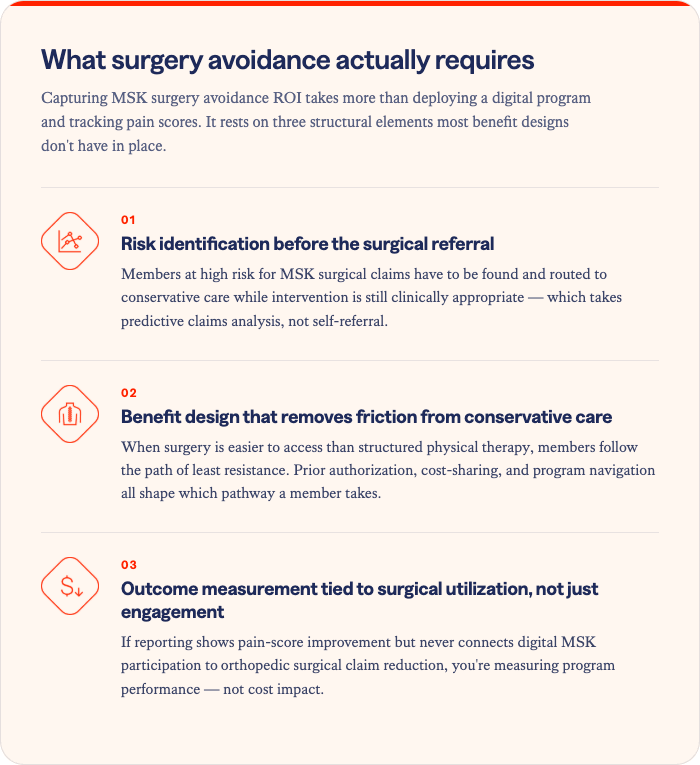
Solera's Precision Insights Suite applies predictive modeling across claims data to identify members trending toward high-cost MSK events before they occur. The HALO Platform routes those members to matched digital programs within the network, with outcomes tracked through medical claims. The result is intervention at the right moment, with a measurement framework that captures the avoidance outcome, not just the clinical one.
The surgery your digital MSK program prevents is worth more than the pain score it improves.
Solera Health connects benefits leaders and health plan executives to evidence-based digital MSK programs, matched to member risk profiles and measured through medical claims outcomes. If your current MSK benefit is not connected to surgical utilization data, you are not seeing the full ROI picture.
Explore Other Resources
6/1/2026

The Network Effect: Proving the Value of Curated Digital Health
$1,241 — Total cost of care reduction per member
5/15/2026
Employer Health Care Costs in 2026: What’s Driving the Spike and What’s Actually Working
Do Digital Health Programs Reduce Employer Health Care Costs?
4/6/2026
Death By a Thousand Vendors: A Study of 106 Senior Benefits Leaders
More vendors. More spend. More headcount. And yet — the problem is getting worse.

.png)
