


1/1/2026
The Benefits Gap Nobody's Talking About: Men's Health and the Utilization Problem
Men in your workforce are sicker than you think — and less likely to do anything about it.
That's not a commentary on willpower. It's a structural problem baked into how men engage with healthcare. And for employers and health plans, it carries a real price tag.
June is Men's Health Month, which tends to produce a reliable wave of content about eating better and going to the doctor. But the more useful conversation for benefits leaders is this: why aren't the men in your member population using the resources you've already invested in? And what does that mean for your claims?
The numbers behind the gap
Men die, on average, five years earlier than women. They're four times more likely to die by suicide. They're more likely to have untreated hypertension before age 45, and more than half of Americans with unmanaged diabetes are men.
And yet men are half as likely as women to seek medical care and 55% don't receive regular health screenings.
This isn't a new story. But it has a new dimension in the age of digital health benefits. Because the same behavioral patterns that keep men out of clinics — the preference to handle things independently, the resistance to scheduling and follow-through, the discomfort with vulnerability — are exactly what digital health programs are designed to work around.
The question is whether your benefits portfolio is set up to reach them.

Why standard benefits design misses them
Most benefits navigation assumes a member who will self-identify a problem, research their options, schedule an appointment, and follow through on a care plan. That behavioral profile skews heavily female.
Men, on average, don't engage that way. They're more likely to act when the entry point feels low-stakes and autonomous — when they don't have to describe how they're feeling to a stranger, when the first step doesn't feel like asking for help, and when the feedback loop is fast enough to hold attention.
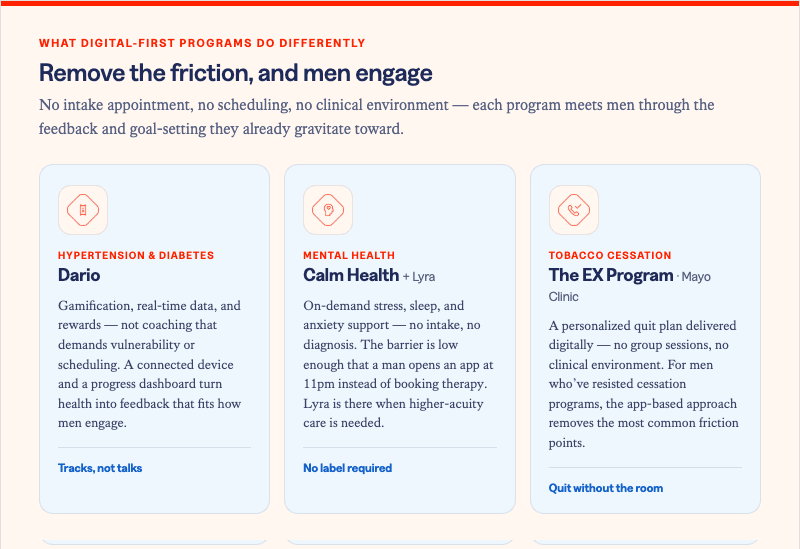
This is where digital health programs have a structural advantage that traditional benefits design doesn't — and where the on-demand, app-first architecture of programs like Dario Health, Calm Health, and EX Program is worth examining specifically through a men's utilization lens.
The employer case
Untreated hypertension. Unmanaged diabetes. Unaddressed mental health. These aren't abstract health concerns — they're the upstream conditions driving your most expensive claims.
Men in your workforce are statistically more likely to carry those conditions and less likely to engage with traditional care pathways to address them. That gap doesn't close on its own. It closes when the programs available to them are designed for how they behave, not how benefits administrators wish they would.
The good news is that digital health programs — particularly those with low entry barriers, data-driven feedback, and on-demand access — are unusually well-suited to this population. The coverage is there. The reach is the variable.
What to look for in your data
If you're a benefits leader evaluating your current digital health portfolio through a men's health lens, a few questions worth asking:
- Utilization by gender: Are men enrolling in your behavioral health and chronic condition programs at rates that reflect their share of the member population?
- Entry points: Do your highest-volume men's health conditions (hypertension, diabetes, weight management) have digital program options that don't require a clinical referral to access?
- Engagement mechanics: Are the programs in your network designed around autonomy, data, and low-friction entry — or do they require a level of self-disclosure that creates drop-off for male members?
Explore Other Resources
6/1/2026

The Network Effect: Proving the Value of Curated Digital Health
$1,241 — Total cost of care reduction per member
5/15/2026
Employer Health Care Costs in 2026: What’s Driving the Spike and What’s Actually Working
Do Digital Health Programs Reduce Employer Health Care Costs?
4/6/2026
Death By a Thousand Vendors: A Study of 106 Senior Benefits Leaders
More vendors. More spend. More headcount. And yet — the problem is getting worse.

.png)
