


1/1/2026
Mental Health vs. Behavioral Health: Why the Language Change Matters for Your Benefits Strategy
Most employer benefits still use the phrase mental health to describe what clinicians, payers, and accreditation bodies now universally call behavioral health. That is not a branding preference. It is a scope problem, and it is quietly shaping which members your benefit reaches, which conditions it covers, and whether it functions as a whole-person health tool or a crisis intervention.
The shift from mental health to behavioral health language happened in the clinical and payer world years ago. It has been slower to reach benefits guides, vendor contracts, and HR communications. For most members, that lag is invisible. For the members whose conditions fall in the gap between the two definitions, it determines whether they receive any support at all.
Understanding the distinction, and designing your benefits architecture around the broader frame, is not a semantic exercise. It is a population coverage decision with direct cost implications.
What mental health covers and what it leaves out
Mental health, in its traditional benefits usage, refers to emotional and psychological conditions: depression, anxiety disorders, PTSD, bipolar disorder, schizophrenia, and related diagnoses. These are real, significant, and well-documented conditions that deserve clinical attention and benefit coverage. The mental health frame captures them well.
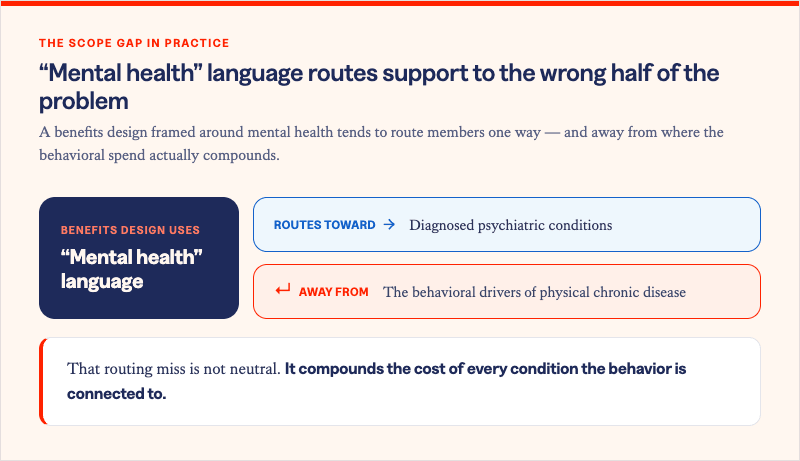
What it does not capture is the full range of conditions that have behavioral drivers, behavioral consequences, or both. Substance use disorders, which affect more than 46 million Americans according to SAMHSA, are classified as behavioral health conditions in every major clinical and regulatory framework but are frequently excluded from or underserved by benefits designs that use mental health language and scope. Eating disorders, which carry the highest mortality rate of any psychiatric diagnosis, sit at the intersection of behavioral, psychological, and physical health in ways that a mental health-only frame handles poorly. Behavioral addictions, including those driving compulsive patterns that exacerbate chronic conditions, are rarely captured at all.
And then there is the behavioral dimension of every chronic physical condition in your portfolio. The member with T2D whose depression is undermining their glucose management is not presenting with a mental health claim. They are presenting with a diabetes claim. The behavioral health driver is invisible until you are looking for it -- and a benefits design framed around mental health is structurally less likely to look for it.
What behavioral health covers and why the broader frame matters
Behavioral health encompasses the full range of conditions, disorders, and patterns in which behavior is either a primary driver or a primary consequence. This includes the traditional mental health diagnoses but extends to substance use disorders, the behavioral dimensions of chronic disease management, compulsive and addictive patterns, and the psychological components of physical health conditions.
The clinical logic for the broader frame is well-established. Behavior is the primary modifiable variable in most chronic disease management. Glycemic control depends on behavioral adherence. Blood pressure management depends on behavioral change. Weight loss depends on behavioral modification. The behavioral health conditions that impair those behaviors, depression, anxiety, substance use, are not separate from the physical conditions they affect. They are operating inside them, shaping their trajectories, and determining whether clinical interventions produce the outcomes they are designed to deliver.
Payers understood this before most employers did. Major health plans, CMS, NCQA, and The Joint Commission all use behavioral health as the organizing framework precisely because it reflects clinical reality more accurately than the narrower mental health term. Benefits designs that have not made this shift are operating on a clinical model that their own carriers have moved past.

What this looks like in the Solera Network
Solera Health uses Behavioral Health as the formal condition area across its network, deliberately and consistently. That choice reflects the clinical reality that behavioral health conditions are comorbid with every major chronic condition Solera addresses, and that the highest-value interventions in the network, those that produce the most durable outcomes in weight management, diabetes, MSK, and hypertension, are the ones that treat behavioral health as an integrated clinical priority rather than a separate referral pathway.
We can identify members carrying both metabolic and behavioral health risk simultaneously, enabling routing to programs designed for clinical complexity before either condition advances to its highest-cost presentation. The HALO Platform tracks outcomes across condition boundaries, connecting behavioral health improvement to chronic disease management in the measurement framework that benefits leaders and CFOs can use to defend the investment.
The language change is a starting point. The architecture that follows from it is where the clinical and financial value is produced.
The shift from mental health to behavioral health is not a rebrand. It is a scope decision that determines which members your benefit reaches and which conditions it is designed to address.
Solera Health connects benefits leaders and health plan executives to evidence-based digital behavioral health programs, integrated across condition areas and matched to member clinical profiles through predictive claims modeling.
Explore Other Resources
6/1/2026

The Network Effect: Proving the Value of Curated Digital Health
$1,241 — Total cost of care reduction per member
5/15/2026
Employer Health Care Costs in 2026: What’s Driving the Spike and What’s Actually Working
Do Digital Health Programs Reduce Employer Health Care Costs?
4/6/2026
Death By a Thousand Vendors: A Study of 106 Senior Benefits Leaders
More vendors. More spend. More headcount. And yet — the problem is getting worse.

.png)
