


1/1/2026
Oncology Is Coming to Digital Health. Here's What Employers Need to Know Now.
Cancer is the number-one driver of catastrophic claims in employer health plans. It is also the condition area where digital health has historically had the least presence. That is starting to change, and benefits leaders who are not paying attention now will be making reactive purchasing decisions in a landscape that moves fast.
This is not a prediction about distant technology. Digital health solutions for oncology navigation, second opinion access, psycho-oncology support, and clinical trial enrollment are operational today. They are being evaluated by large employers and health plans in procurement cycles happening right now. The question for benefits leaders is not whether oncology digital health will arrive in their portfolio. It is whether they will be positioned to evaluate it rigorously when it does.
This post is not a product pitch. It is a framework for understanding what digital health in oncology is, what it is not, what it should cost to deliver, and how it connects to the prevention and comorbidity management investments employers are already making.
The cost burden that makes oncology a benefits priority
Cancer is responsible for approximately one in every five dollars of catastrophic health claims in large employer populations. The average total cost of a cancer case, from diagnosis through treatment and survivorship care, routinely exceeds $150,000. For high-acuity malignancies such as lung, pancreatic, or hematologic cancers, total cost of care can exceed $500,000 per member.
What makes cancer uniquely expensive from a benefits management perspective is not just the treatment cost. It is the combination of diagnostic delay, misdiagnosis, treatment variation, and the psychosocial cost burden that surrounds every case. Research consistently shows that cancer patients treated at high-volume, specialized centers have materially better outcomes than those treated at community facilities, and that outcomes differences translate directly to cost differences through reduced complications, lower readmission rates, and shorter treatment timelines.
The implication for benefits leaders is direct: the cost of a cancer case is not fixed at diagnosis. It is shaped by the decisions made in the first 30 to 90 days. Whether a member receives an accurate diagnosis, whether their treatment plan is confirmed by a specialist, whether they have behavioral health support to maintain treatment adherence, and whether they have access to a clinical trial that could replace a standard regimen, all of these variables move the cost needle significantly.

What digital health is actually doing in oncology
The category labeled digital oncology covers a spectrum of offerings with very different clinical and financial value. Benefits leaders evaluating this space should understand what each component does and what it is worth before any procurement conversation begins.
- Oncology navigation. The most established and highest-ROI component. Nurse navigator programs help members move through a complex, fragmented care system with a guide who understands the clinical pathway, the insurance landscape, and the member's specific diagnosis. Navigation reduces the time from diagnosis to treatment initiation, reduces inappropriate emergency utilization during active treatment, and improves member experience during an extremely high-stakes period.
- Second opinion access. Research estimates that a meaningful percentage of cancer diagnoses, some studies put this as high as 20%, involve a material change in diagnosis or treatment plan when reviewed by a specialist at a high-volume cancer center. For benefits leaders, a second opinion that changes a treatment plan from an aggressive surgical intervention to a targeted therapy, or that confirms a diagnosis that was initially missed, represents cost avoidance with a clear, traceable claims impact.
- Psycho-oncology support. Depression and anxiety affect a substantial majority of cancer patients during active treatment. Untreated behavioral health conditions during oncology care are associated with lower treatment adherence, higher symptom burden, increased emergency utilization, and worse survival outcomes in several cancer types. Behavioral health integration is not a soft benefit in oncology. It is a clinical quality driver with direct cost implications.
- Clinical trial enrollment. Fewer than 5% of eligible cancer patients in the United States enroll in clinical trials. For members with certain diagnoses, a matched clinical trial may offer access to treatments that are more effective, less toxic, and fully covered under trial sponsorship, reducing plan cost while improving outcomes. Digital platforms that systematically screen members for trial eligibility and remove enrollment friction represent a genuine access gap intervention.
What employers should look for in an oncology digital health offering
The oncology digital health market is early-stage and, as with every early digital health category, the quality and accountability of offerings varies significantly. Benefits leaders evaluating this space should apply the same rigor they have learned to apply elsewhere in their portfolio.
- Claims-linked outcome measurement. Any oncology digital health program should be able to demonstrate its impact through medical claims data, not member satisfaction surveys or self-reported quality-of-life scores. The relevant metrics are time-to-treatment-initiation, rates of specialist confirmation, emergency utilization during treatment, and total cost of care compared to matched non-enrolled members.
- Behavioral health integration. A navigation or second opinion program that does not include structured behavioral health support for the member and their caregivers is leaving one of the highest-impact intervention opportunities unaddressed. Psycho-oncology support should be built into the model, not offered as an optional add-on.
- Population identification methodology. The program should be able to identify newly diagnosed members and high-risk members proactively through claims data, not rely entirely on self-referral. Self-referral systematically misses the members with the lowest health literacy, the least time, and the highest acuity, which is exactly the population where navigator support delivers the most value.
- Accountability structure. Performance-based contracts that tie program fees to documented outcomes are the standard that separates programs with genuine confidence in their results from those that are not. If a vendor is unwilling to structure payment around claims-linked outcomes, ask why.
Oncology does not exist outside your existing benefits portfolio
The most important framing shift for benefits leaders thinking about digital oncology is this: cancer is not a separate category that requires a separate strategy. It is the downstream consequence of the modifiable risk factors that every other condition program in your portfolio is designed to address.
Benefits leaders who manage these condition areas as integrated, interconnected investments are already doing oncology prevention. The addition of a structured oncology navigation and support offering completes the picture, connecting the prevention investments already in place to the acute care support that members need when prevention is not enough.
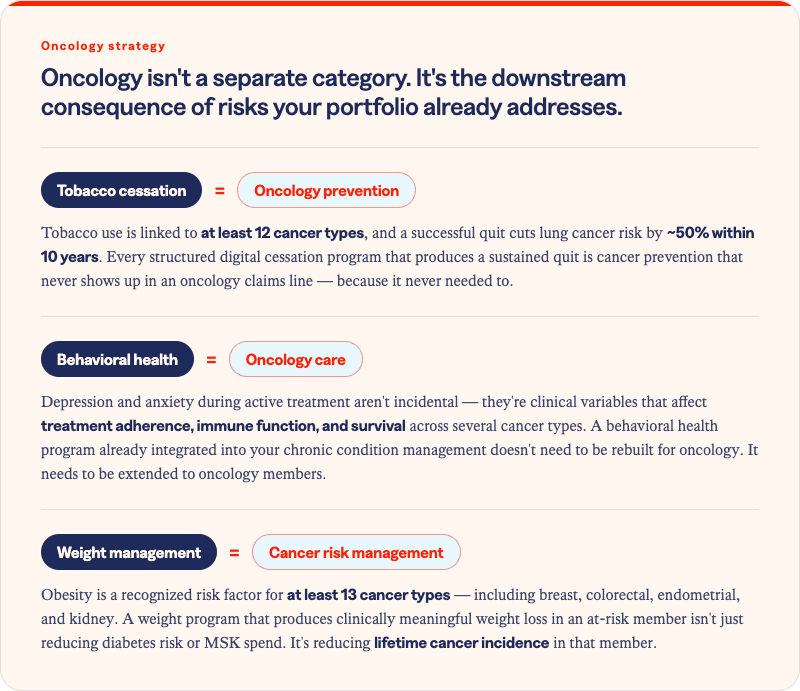
The employers who will manage oncology costs most effectively are not those who react when a catastrophic claim arrives. They are the ones who have built the prevention, behavioral health, and navigation infrastructure before it does.
Solera Health connects benefits leaders and health plan executives to evidence-based digital health programs across condition areas, with integrated behavioral health, tobacco cessation, and weight management programs that address the upstream risk factors that drive oncology cost. As the digital oncology landscape matures, Solera's integrated model is designed to extend into cancer navigation and support in a way that connects to the rest of your portfolio, not sits outside it.
Explore Other Resources
6/1/2026

The Network Effect: Proving the Value of Curated Digital Health
$1,241 — Total cost of care reduction per member
5/15/2026
Employer Health Care Costs in 2026: What’s Driving the Spike and What’s Actually Working
Do Digital Health Programs Reduce Employer Health Care Costs?
4/6/2026
Death By a Thousand Vendors: A Study of 106 Senior Benefits Leaders
More vendors. More spend. More headcount. And yet — the problem is getting worse.

.png)
