


1/1/2026
The Comorbidity No One Talks About: Postpartum Depression and Its Downstream Cost Impact
One in seven women experiences postpartum depression. That is not a rare clinical event. It is the most common complication of childbirth, and for most benefits leaders, it is invisible on the claims ledger until it is not.
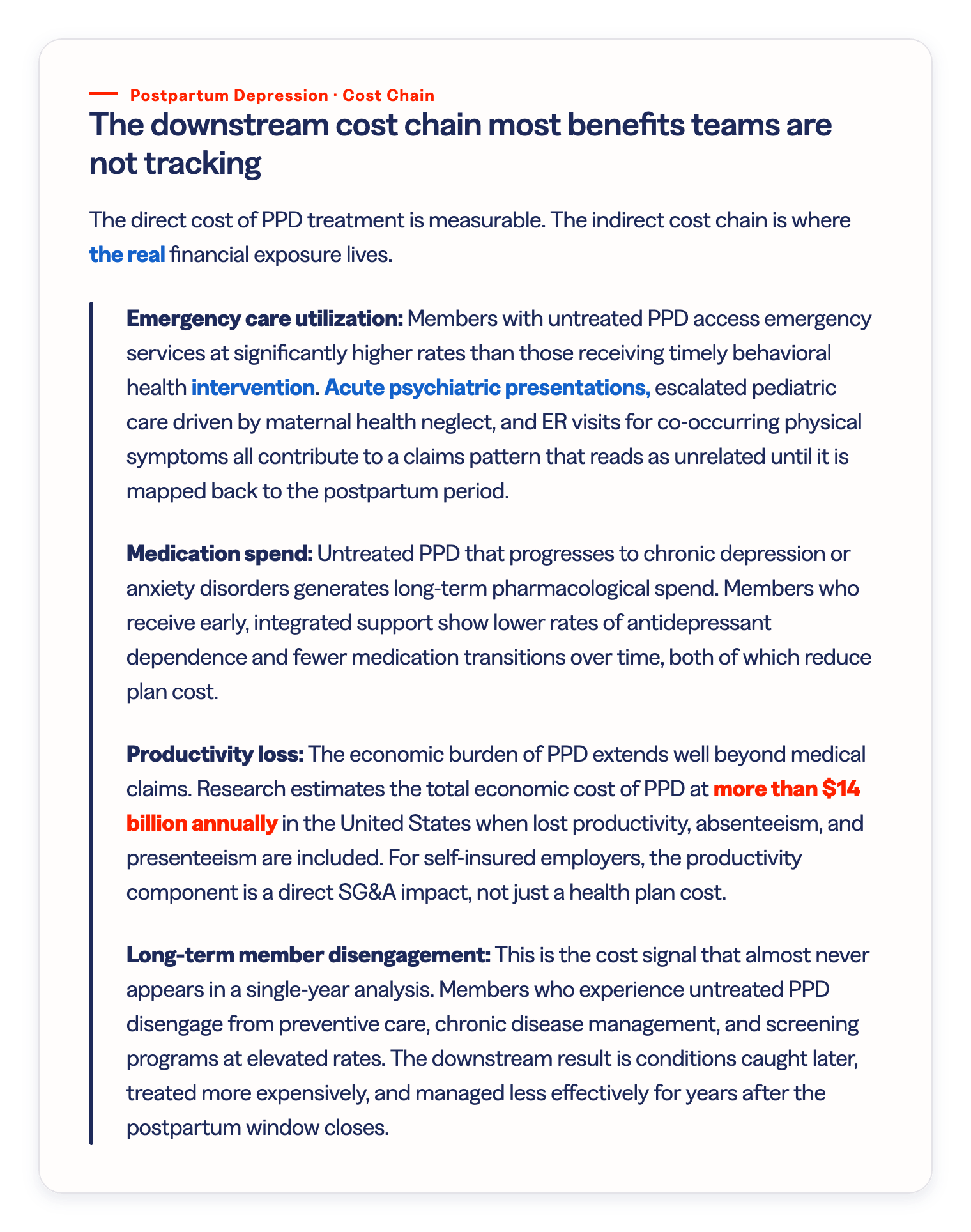
PPD does not look like a catastrophic claim. It looks like a member who misses follow-up appointments. Who stops refilling prescriptions. Who shows up in the emergency department six months later with an acute episode that did not have to happen. Who quietly disengages from the health system and takes two or three years to re-engage, if she does at all.
That pattern has a cost. It is distributed across multiple claim categories, which is exactly why it goes unaddressed. Benefits teams are not looking for the postpartum signal. They are managing diabetes spend, MSK utilization, and behavioral health trend lines, often without realizing that untreated PPD is feeding all three over time.
PPD is a comorbidity of pregnancy, not a separate mental health benefit
The framing problem starts here. Most benefits architectures treat postpartum depression as a behavioral health issue, routed to an EAP, a mental health app, or a standalone therapy benefit that a member has to find and navigate on her own during one of the most demanding periods of her life.
That framing is clinically incorrect and operationally costly. PPD is not a standalone condition that happens to follow childbirth. It is a comorbidity of pregnancy, as predictable and screenable as gestational diabetes, and with a comparable downstream cost footprint when left unmanaged.
Untreated PPD is associated with higher rates of chronic depression, anxiety disorders, and PTSD in the 12 to 24 months following delivery. The member who does not receive timely, integrated support is not simply a behavioral health cost today. She is a behavioral health, cardiometabolic, and MSK cost over the next three to five years.
Benefits leaders who manage PPD as a mental health routing problem are solving for the wrong variable.
What the 1-in-7 statistic means for a self-insured population
In a workforce of 10,000 covered lives, the actuarial math is straightforward. If roughly 15% of birthing members experience PPD, and the average employer health plan covers between 500 and 1,500 pregnancies annually depending on workforce demographics, untreated PPD represents a predictable, recurring, and compounding cost exposure.
It is not a low-frequency catastrophic event. It is a high-frequency, moderate-severity condition that accumulates across claim categories and across years. The cost of early, integrated intervention is a fraction of the downstream cost of inaction.
And yet, most benefits designs do not include a structured postpartum behavioral health pathway. Maternity benefits end at the delivery event. Behavioral health benefits require self-directed navigation. The gap between those two benefit structures is exactly where the cost accumulates.
What integrated management looks like
Addressing PPD as a comorbidity of pregnancy rather than a standalone behavioral health event requires a different benefits architecture than most employers currently operate.
It requires screening at the point of postpartum care, not after a member has already disengaged. The Edinburgh Postnatal Depression Scale is a validated, widely used screening tool. The question is whether the results are connected to a care pathway or simply filed.
It requires care navigation that bridges Women's Health and Behavioral Health as connected benefit categories, not siloed programs. A member who screens positive for PPD should not be handed a phone number. She should be routed to a program that addresses her clinical profile, at a moment when friction is the single greatest barrier to engagement.
It requires outcome measurement that follows the member past the postpartum window, tracking behavioral health utilization, chronic condition development, and re-engagement with preventive care over a 12 to 24 month horizon. That is the measurement frame that reflects the actual cost curve.
Solera Health's network addresses both Women's Health and Behavioral Health as integrated condition areas, with evidence-based digital programs matched to members based on clinical profile and risk. For postpartum members, that means access to structured behavioral health support at the moment it is clinically indicated, without requiring her to navigate a fragmented benefits system on her own.
PPD is screenable, treatable, and financially addressable. The question is whether your benefits architecture is designed to do any of the three.
Solera Health connects benefits leaders and health plan executives to evidence-based digital health programs spanning Women's Health and Behavioral Health, matched to member clinical profiles and measured through medical claims outcomes.
Explore Other Resources
6/1/2026

The Network Effect: Proving the Value of Curated Digital Health
$1,241 — Total cost of care reduction per member
5/15/2026
Employer Health Care Costs in 2026: What’s Driving the Spike and What’s Actually Working
Do Digital Health Programs Reduce Employer Health Care Costs?
4/6/2026
Death By a Thousand Vendors: A Study of 106 Senior Benefits Leaders
More vendors. More spend. More headcount. And yet — the problem is getting worse.

.png)
