


1/1/2026
The Hidden Multiplier: How Behavioral Health Affects Every Other Condition in Your Portfolio
Members with a chronic condition and an untreated behavioral health comorbidity do not cost twice as much as members with the chronic condition alone. They cost materially more. That gap is not explained by the behavioral health diagnosis. It is explained by what untreated behavioral health does to the clinical outcomes, the medication adherence, and the utilization patterns of every other condition the member is managing.
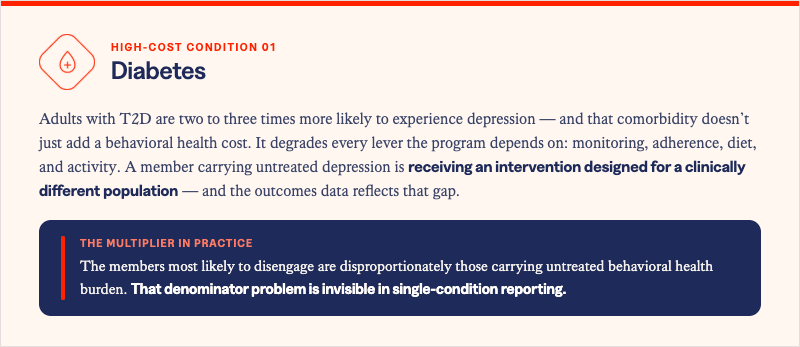
Behavioral health is not a separate cost category in your claims portfolio. It is a multiplier applied to every other category. The member with diabetes and untreated depression does not just generate behavioral health spend. They generate worse diabetes outcomes, higher acute care utilization, lower medication adherence, and faster progression to the complications that produce catastrophic claims.
Most employer benefits architectures are not designed to see this. Behavioral health is routed to an EAP or a standalone mental health benefit, tracked in its own reporting silo, and evaluated on access metrics and session counts rather than its impact on the conditions it is silently amplifying across the rest of the portfolio.
That is the structural failure. And it is costing more than the behavioral health line item reflects.
Why the EAP model cannot capture the cost multiplier
Employee assistance programs were designed to address short-term personal crises: workplace stress, bereavement, relationship problems, brief episodes of anxiety. They were not designed to address the persistent, clinically significant behavioral health burden that co-occurs with chronic physical conditions at scale.
The EAP model has three structural limitations that prevent it from functioning as a clinical cost management tool. First, utilization is self-directed: members with the most significant behavioral health burden, those managing depression alongside chronic disease, are the least likely to self-navigate to a resource they do not know exists or feel stigmatized about accessing. Second, session limits cap the intervention at exactly the moment sustained engagement begins to produce clinical benefit. Third, EAP outcomes are measured in isolation, with no visibility into the member's chronic condition claims, no shared data with their diabetes or MSK program, and no accountability for what happens to their A1C or their pain score after they complete their sessions.
An EAP is not an integrated behavioral health strategy. It is access infrastructure for a narrow use case, deployed as if it were the full solution to a much larger problem.
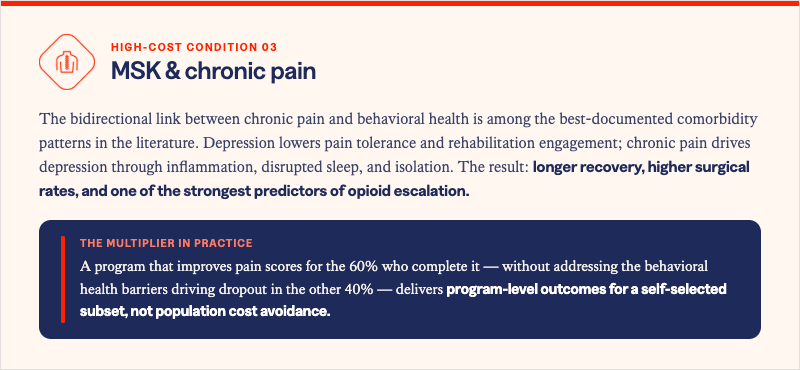
The behavioral health multiplier across your highest-cost conditions


What integrated behavioral health looks like in practice
Addressing behavioral health as a clinical cost multiplier rather than a standalone benefit category requires three structural changes that most benefits designs have not yet made.
- Shared data across condition programs. If a member's diabetes program vendor cannot see their behavioral health utilization, and their behavioral health program cannot see their A1C trend, there is no integration. There is parallel management of conditions that are clinically inseparable.
- Behavioral health screening embedded in every condition program. Screening at intake for depression and anxiety should not be optional or member-initiated. It should be a standard component of every chronic condition enrollment, with a defined clinical protocol for what happens when a member screens positive.
- Outcome measurement that crosses condition boundaries. If your behavioral health vendor reports session completion and your diabetes vendor reports A1C improvement but neither report connects to the other, you are measuring program performance in two silos. The measurement that matters is what happens to A1C, blood pressure, pain scores, and surgical rates when behavioral health is integrated at the population level.
Solera Health's network addresses Behavioral Health as a connected condition area across Weight Management, Diabetes, MSK, and Hypertension programs, identifying members carrying elevated health risk and routing them to programs designed for clinical complexity. Outcomes are tracked through medical claims across condition boundaries, not within them.
Behavioral health is not a line item in your benefits portfolio. It is the variable that determines whether every other line item performs.
Solera Health connects benefits leaders and health plan executives to evidence-based digital health programs spanning Behavioral Health, Diabetes, MSK, Hypertension, and Weight Management, matched to member clinical profiles and measured through integrated medical claims outcomes.
Explore Other Resources
6/1/2026

The Network Effect: Proving the Value of Curated Digital Health
$1,241 — Total cost of care reduction per member
5/15/2026
Employer Health Care Costs in 2026: What’s Driving the Spike and What’s Actually Working
Do Digital Health Programs Reduce Employer Health Care Costs?
4/6/2026
Death By a Thousand Vendors: A Study of 106 Senior Benefits Leaders
More vendors. More spend. More headcount. And yet — the problem is getting worse.

.png)
