


1/1/2026
The Real Cost of Diabetes in Your Benefits Portfolio: Beyond the Diagnosis
The $9,600 average annual cost of managing a diagnosed T2D member is a floor, not a ceiling. That figure captures medication, monitoring, and physician visits for a member whose diabetes is the primary diagnosis. It does not capture the member whose diabetes exists alongside hypertension, depression, chronic back pain, and hyperlipidemia -- which describes the majority of T2D members in any large employer or health plan population.
Diabetes is rarely a standalone condition. It is the organizing diagnosis around which other expensive conditions cluster. Managing it in isolation, through a diabetes-only point solution that does not account for what is happening across the rest of that member's claims, is one of the most common and most costly structural errors in employer benefits design.
The real cost of diabetes in your benefits portfolio is not what a single-condition diabetes management program measures. It is the aggregate claims impact of a population whose conditions interact, amplify each other, and require a fundamentally different management approach than any one of them demands alone.
The comorbidity burden that defines the T2D population
The clinical profile of the average T2D member in a commercial population is not a person managing glucose levels. It is a person managing glucose levels while also managing blood pressure, mood, joint pain, and lipid abnormalities, often with separate providers, separate programs, and no clinical coordination between any of them.
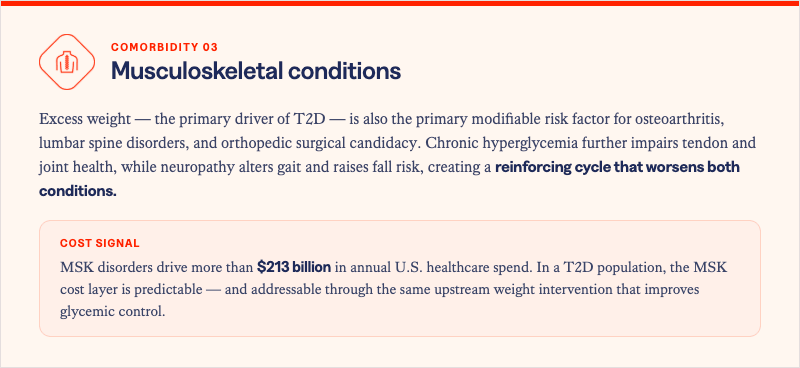
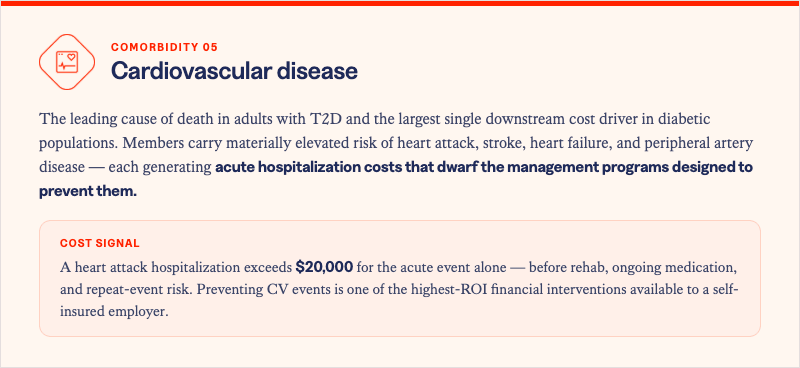
Research consistently shows that adults with type 2 diabetes carry elevated rates of comorbid conditions across every major disease category. The conditions below appear at meaningfully higher rates in T2D populations than in the general adult population, and each one adds independently to total medical spend while also worsening glycemic outcomes.

Five comorbidities and what each one adds to the cost equation



Why siloed management fails the comorbidity reality
A diabetes point solution that manages A1C without visibility into a member's blood pressure, lipid status, behavioral health burden, and MSK utilization is managing one variable in a system it cannot see. The interventions it recommends are calibrated for a population it is not serving. And the outcomes data it reports reflect program performance in a more favorable population than the one enrolled in your plan.
Integrated condition management, where diabetes, hypertension, behavioral health, and weight management are addressed as interconnected rather than parallel programs, does not just produce better clinical outcomes. It produces a fundamentally different cost trajectory for the members whose conditions interact. That trajectory is measurable through claims, attributable to the integrated model, and defensible in a CFO conversation in a way that siloed program ROI rarely is.
Solera Health's network addresses these condition areas as an integrated system. The result is a benefits investment measured against the actual cost problem, not the diagnostic label.
The diagnosis is where the claims conversation starts. The comorbidity cluster is where the cost actually lives.
Solera Health connects benefits leaders and health plan executives to evidence-based integrated digital health programs spanning diabetes, behavioral health, weight management, hypertension, and MSK, matched to member clinical profiles and measured through medical claims outcomes.
Explore Other Resources
6/1/2026

The Network Effect: Proving the Value of Curated Digital Health
$1,241 — Total cost of care reduction per member
5/15/2026
Employer Health Care Costs in 2026: What’s Driving the Spike and What’s Actually Working
Do Digital Health Programs Reduce Employer Health Care Costs?
4/6/2026
Death By a Thousand Vendors: A Study of 106 Senior Benefits Leaders
More vendors. More spend. More headcount. And yet — the problem is getting worse.

.png)
