


1/1/2026
Weight Management Is Not a Wellness Program. It Is a Cost Management Strategy
Obesity-related medical costs now exceed $173 billion annually in the United States. That is not a wellness statistic. That is a line item on your balance sheet.
And yet, most employers still categorize weight management as a wellness perk. A gym membership subsidy. A coaching app buried in a benefits portal no one opens. A box checked on an annual wellbeing survey.
That framing is costing you. Not metaphorically. Literally. And the longer benefits leaders allow it to persist, the more financial exposure accumulates in conditions that could have been intercepted years earlier.
The real cost of obesity is not what members weigh. It is what they spend.
Obesity does not exist in isolation. It is the upstream driver of the most expensive conditions in your claims portfolio: type 2 diabetes, musculoskeletal disorders, hypertension, cardiovascular disease, and behavioral health comorbidities. When a member carries excess weight, they are not just a wellness concern. They are a predictable, quantifiable cost trajectory.
The numbers are direct. A member with obesity costs, on average, $1,850 more per year in medical spend than a healthy-weight peer. Over a three-year period, that differential compounds. Solera Health's analysis of claims data across its network estimates $4,577 in three-year medical savings per obese member who achieves and sustains a 5% reduction in body weight.
Five percent. That is not a dramatic transformation. That is a clinically significant, evidence-supported threshold that triggers measurable physiological change, and measurable cost change.
What a 5% weight reduction actually buys you
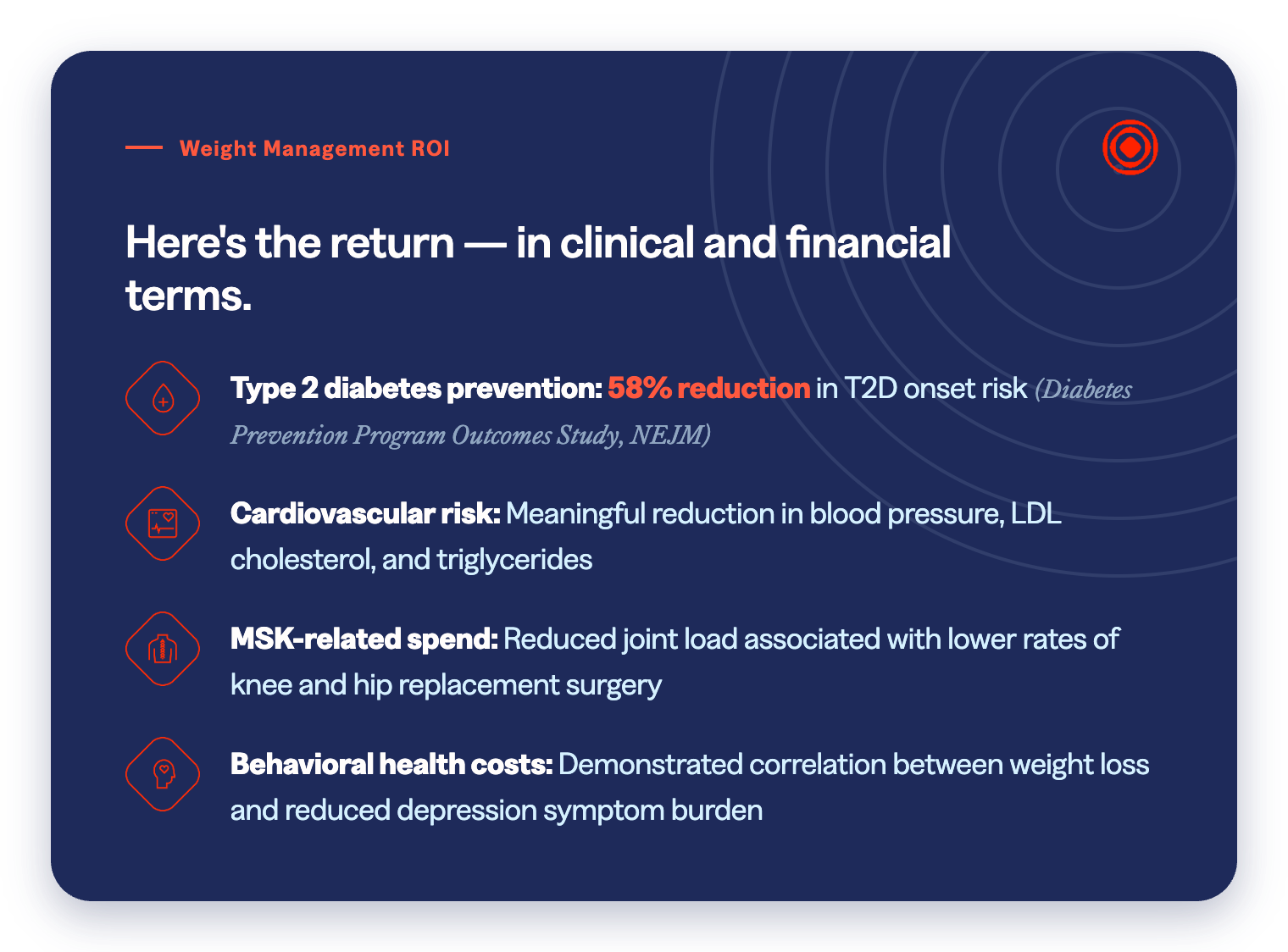
The Diabetes Prevention Program, one of the most rigorous clinical studies in metabolic health, found that a modest 5-7% weight reduction reduced T2D onset by 58% in high-risk adults. For context: metformin, the standard pharmacological intervention, achieved only a 31% reduction in the same population.
The financial translation is straightforward. The average annual cost of managing a member with type 2 diabetes exceeds $9,600. Preventing even a fraction of those cases across a population of 10,000 or 50,000 lives produces returns that dwarf the cost of even a premium digital weight management program.
And that is before accounting for the downstream MSK savings, the reduced cardiovascular event costs, or the behavioral health spend that correlates with unmanaged metabolic disease.
Why wellness program framing fails the CFO test
Wellness programs operate on an implicit logic: invest in employee health, improve morale, reduce absenteeism, and hope the savings appear somewhere in your trends over time. That logic is not wrong. It is just not financeable.
CFOs do not approve spend on hope. They approve spend on outcomes. And the structural problem with most wellness-oriented weight management benefits is that they are designed for engagement, not accountability. Participation is the metric. Claims impact is an afterthought.
The contrast with a cost management framing is stark. When weight management is positioned as a clinical intervention tied to claims outcomes, it becomes possible to measure medical spend reduction, not just step counts. It becomes possible to model population-level savings before a program launches. It becomes possible to hold a vendor accountable to actual results.
That is not a wellness conversation. That is a strategic benefits investment conversation. And it belongs in a different room, with different stakeholders, using different metrics.
The downstream conditions nobody is connecting to weight
Ask your benefits team which conditions are driving the largest year-over-year cost increases. The answer is almost always some combination of musculoskeletal disorders, cardiometabolic conditions, and behavioral health claims.
Ask how many of those members carry a secondary diagnosis of obesity or metabolic risk. The number is rarely tracked. It should be.
Musculoskeletal disorders alone account for more than $213 billion in annual spend across the U.S. healthcare system. Excess body weight is a primary modifiable risk factor for osteoarthritis, lumbar spine disorders, and the surgical interventions that follow. Members who lose weight don't just feel better. They generate fewer orthopedic claims.
The same pattern holds for hypertension. For cardiovascular disease. For sleep apnea, which carries a substantial downstream cost burden through comorbid conditions and productivity loss. Weight is not a separate issue. It is the connective tissue between many of your costliest categories.
How Solera approaches weight management differently
Solera Health does not offer a single weight management program. It offers access to a curated network of evidence-based digital health programs, matched to members based on clinical profile, preference, and risk stratification, and billed through medical claims rather than wellness line items.
That distinction matters structurally. When a weight management program runs through medical claims, it is subject to the same outcome accountability as any other clinical intervention. When it is a wellness benefit, it often is not.
Solera's Precision Insights Suite uses predictive modeling across claims data to identify members at highest risk before costly events occur. For weight management specifically, that means surfacing members trending toward diabetes, MSK surgery, or cardiovascular events while there is still time to intercept. The result is intervention at the right moment, with the right program, for the member most likely to respond.
Across Solera's network, clients see an average of 4.1% reduction in overall medical spend when digital health programs are integrated through the HALO Platform. Weight management is a meaningful contributor to that figure, not because it is magic, but because it addresses the upstream conditions driving downstream costs.
What benefits leaders should demand from any weight management vendor
If you are currently evaluating weight management programs or renegotiating existing contracts, the following questions will separate genuine cost management tools from wellness program wrappers:
- Can you show me claims-linked outcomes data, not engagement metrics?
- What is your documented T2D prevention rate among high-risk participants?
- How do you connect weight loss outcomes to downstream MSK and cardiovascular spend reduction?
- Is your billing model performance-based or participation-based?
- Can you model expected savings for my population before we sign?
If a vendor cannot answer those questions, they are selling wellness. Not outcomes.
The frame shift that changes everything
Reclassifying weight management as a cost management strategy is not semantic. It changes which leaders are in the room. It changes which metrics define success. It changes how vendors are held accountable and how programs are funded.
Benefits leaders who make this shift stop asking whether a weight management program is a good idea. They start asking which program, for which members, with what projected savings, measured how, and accountable to whom.
That is a conversation with real answers. And those answers, backed by claims data and a network designed around outcomes rather than engagement, can produce the kind of ROI that survives a CFO review.
See what weight management looks like as a cost management strategy.
Solera Health connects benefits leaders and health plan executives to evidence-based digital weight management programs, matched to member risk profiles and measured through medical claims. If your current approach does not include claims-based outcomes accountability, it is time to see what a different model delivers.
Explore Other Resources
6/1/2026

The Network Effect: Proving the Value of Curated Digital Health
$1,241 — Total cost of care reduction per member
5/15/2026
Employer Health Care Costs in 2026: What’s Driving the Spike and What’s Actually Working
Do Digital Health Programs Reduce Employer Health Care Costs?
4/6/2026
Death By a Thousand Vendors: A Study of 106 Senior Benefits Leaders
More vendors. More spend. More headcount. And yet — the problem is getting worse.

.png)
