


1/1/2026
What 5% Body Weight Loss Actually Does to a Health Plan's Claims
Five percent. That is the body weight reduction threshold at which clinically significant, measurable physiological change begins occurring across multiple chronic conditions simultaneously. It is not a dramatic number. It is, however, the number that should anchor every conversation about weight management ROI in a health plan or self-insured employer setting.
Most health plan conversations about weight management get stuck on the intervention cost: program fees, utilization rates, administrative overhead. The more consequential question is what happens in claims across multiple categories when a meaningful share of an obese population crosses this threshold and stays there.
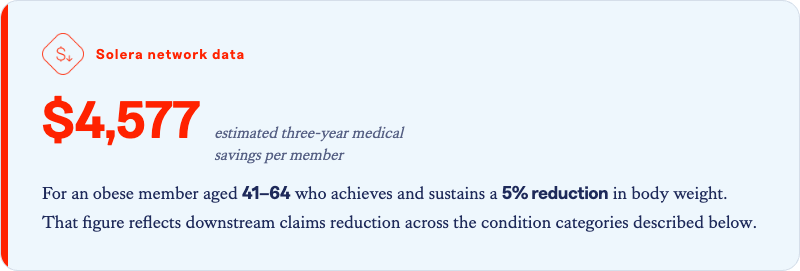
The answer, drawn from clinical trial data and actuarial modeling, is specific and substantial. Here is what 5% body weight loss actually does, condition by condition, and what that translates to in claims category terms for medical directors and finance executives managing large populations.
The 5% threshold: why this number and not another
The 5% threshold is not arbitrary. It reflects the point at which adipose tissue reduction begins producing measurable downstream effects on metabolic, cardiovascular, and musculoskeletal function. Below this threshold, clinical benefits are modest and inconsistent. At and above it, the evidence base is robust and reproducible across populations.
Critically, 5% is achievable. It does not require a dramatic transformation. For a 250-pound member, it means 12.5 pounds. For a 200-pound member, it means 10 pounds. These are targets that structured digital weight management programs, with behavioral coaching, clinical oversight, and accountability milestones, can document at scale. The clinical significance is real. The population-level claims impact is compounding.
Type 2 diabetes: the single largest downstream claims impact
The Diabetes Prevention Program Outcomes Study, one of the most rigorous longitudinal trials in metabolic health, found that a 5-7% reduction in body weight through lifestyle intervention reduced the onset of type 2 diabetes by 58% in high-risk adults. This figure has been replicated across populations and represents the foundation of the CDC's National Diabetes Prevention Program.
For health plan medical directors, the claims translation isdirect. The average annual cost of managing a member with type 2 diabetes exceeds $9,600 per year, including medications, monitoring supplies, physician visits, and diabetes-related complications. A high-risk member who does not develop T2D as a result of achieving and sustaining weight loss does not enter that cost chain. Across a population of 50,000 lives with a meaningful prevalence of metabolic risk, preventing even a fraction of projected T2D cases produces seven-figure annual claims avoidance.
The comparison to pharmacological intervention is instructive. Metformin, the standard first-line medication for T2D prevention in high-riskadults, achieves a 31% risk reduction in the same population. The lifestyle intervention that produces 5% weight loss outperforms the drug on the primary outcome, at lower long-term cost and without the medication adherence burden.
Musculoskeletal claims: surgical avoidance through reduced joint load
The biomechanical relationship between body weight and joint stress is well-established. Each pound of body weight translates to approximately four pounds of force on the knee joint during normal gait. For amember who loses 10 pounds, that represents 40 pounds of reduced compressive load per step, across every step taken throughout the day.
The clinical consequence is a measurable reduction in the rat eof osteoarthritis progression, lower rates of knee and hip replacement surgery in members with existing joint disease, and reduced lumbar spine load associated with lower back pain and spinal surgical risk. For health plans carrying significant MSK surgical volume, this is not a marginal effect. MSK disorders account for more than $213 billion in annual U.S. healthcare expenditure, and excess body weight is among the most modifiable upstream contributors to that figure.
Members in the obese BMI range who achieve and sustain 5%weight loss show lower rates of orthopedic surgical referral and reducedpost-surgical complication rates when surgery does occur. Both outcomes reduce plan cost: fewer surgeries filed, and lower acuity on the surgeries that are filed.
Cardiovascular and hypertension claims: the blood pressure effect
A 5% reduction in body weight produces a clinically meaningful reduction in systolic blood pressure, typically in the range of 3-8 mmHg,through mechanisms including reduced vascular resistance, lower circulating blood volume, and improved endothelial function. For members in the Elevated orStage 1 hypertension category under current ACC/AHA guidelines, this magnitude of blood pressure reduction can move them below the threshold requiring pharmacological management.
The claims impact operates at two levels. First, members who achieve blood pressure normalization through weight loss do not start antihypertensive medication regimens, avoiding $300 to $900 in annual drug costs per member plus the monitoring and titration visits that accompany ongoing pharmacological management. Second, and more significantly, sustained blood pressure reduction reduces long-term cardiovascular event risk. Aprevented cardiac hospitalization avoids a claim that routinely exceeds $50,000. A prevented stroke avoids rehabilitation and long-term care costs that can extend for years.
Translating clinical outcomes to population-level claims strategy
The three-condition framework above is not additive in a simple sense. Type 2 diabetes risk, musculoskeletal burden, and cardiovascular disease share upstream risk factors and interact clinically, which means that weight loss at the 5% threshold does not produce isolated improvements in each category independently. It produces a cascade of interconnected benefits that compound over time and across claim categories simultaneously.
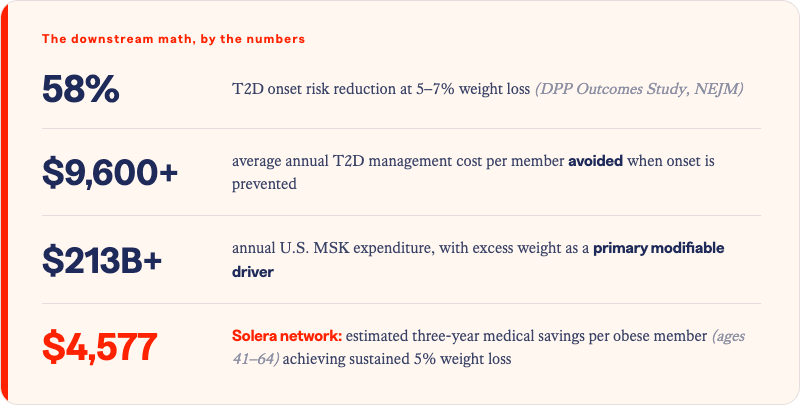
For medical directors modeling population health investment priorities, the 5% threshold represents a defensible, achievable, and financially significant intervention target. For CFOs evaluating digital weight management programs, the question is not whether this level of weight loss produces claims impact. It does, across multiple categories, with compounding returns. The question is whether the program in your portfolio is designed to document it.
The clinical case for 5% weight loss is built. The population-level claims case for investing in it is equally strong.
Solera Health connects health plan medical directors and finance executives to evidence-based digital weight management programs, matched tomember risk profiles through predictive claims modeling, and measured against verified weight loss milestones and downstream medical cost reduction.
Explore Other Resources
6/1/2026

The Network Effect: Proving the Value of Curated Digital Health
$1,241 — Total cost of care reduction per member
5/15/2026
Employer Health Care Costs in 2026: What’s Driving the Spike and What’s Actually Working
Do Digital Health Programs Reduce Employer Health Care Costs?
4/6/2026
Death By a Thousand Vendors: A Study of 106 Senior Benefits Leaders
More vendors. More spend. More headcount. And yet — the problem is getting worse.

.png)
