


1/1/2026
What A1C Reduction Actually Means for Your Claims Data
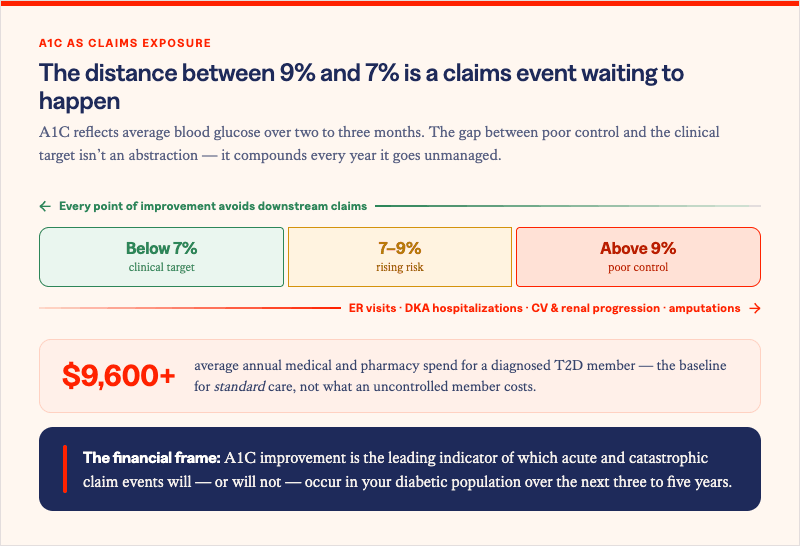
A1C is the standard measure of long-term glycemic control in members with type 2 diabetes. It reflects average blood glucose levels over the prior two to three months and is expressed as a percentage. A1C below 7% is the clinical target for most diabetic adults. A1C above 9% indicates poor control and is the threshold at which acute complication risk rises sharply. The distance between those two numbers is not a clinical abstraction. It is a claims exposure that compounds every year it goes unmanaged.
Most discussions of diabetes management ROI stay at the program level: cost per participant, engagement rates, average A1C improvement. Those are useful program metrics but they are not the number that belongs in a CFO conversation. The number that belongs there is what happens to your claims when a meaningful share of your uncontrolled diabetic population moves from above 9% A1C to below 7%.
Here is that translation, category by category.
The cost baseline: what uncontrolled diabetes actually generates
The average annual medical cost of managing a diagnosed T2D member exceeds $9,600 per year in combined medical and pharmacy spend. That figure represents the baseline for a member receiving standard diabetes care. It does not represent what an uncontrolled diabetic member costs.
Members with persistently elevated A1C, above 9%, generate materially higher utilization than those in controlled range. The difference is not marginal. Uncontrolled diabetes is associated with emergency department visits for acute glycemic events, hospitalizations for diabetic ketoacidosis, accelerated progression of cardiovascular and renal complications, and higher rates of lower-limb amputations, all of which generate claim events that dwarf the cost of the management program that could have prevented them.
Emergency care and acute hospitalization: the immediate cost signal
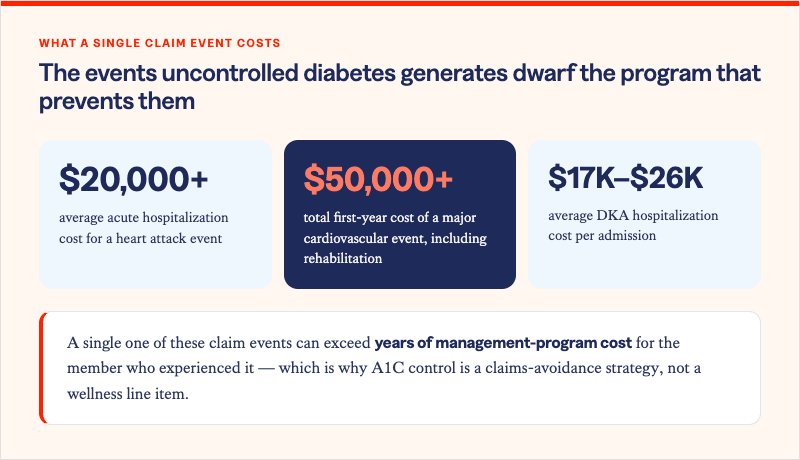
Diabetic ketoacidosis is the acute complication most directly associated with uncontrolled A1C. DKA occurs when insulin levels are insufficient to prevent the breakdown of fat for energy, producing a dangerous accumulation of ketones. It is almost entirely preventable with consistent glycemic management. It is also consistently expensive: the average DKA hospitalization costs $17,000 to $26,000 per admission, with a median inpatient stay of three to four days.
Members with A1C above 9% are significantly more likely to present with DKA than those in controlled range. A diabetes management program that moves a cohort of uncontrolled members into controlled range does not just improve a clinical metric. It removes a recurring acute hospitalization risk from your claims ledger.
The same logic applies to emergency department utilization more broadly. Hypoglycemic episodes, hyperglycemic crises, and acute infections secondary to impaired immune function all generate ED claims in uncontrolled diabetic populations at rates substantially higher than in controlled ones. Each avoided ED visit is a claim that does not appear in your year-end trend.
Cardiovascular complications: the largest long-term cost exposure
Cardiovascular disease is the leading cause of death in adults with type 2 diabetes and the largest single downstream cost driver in diabetic populations. The relationship between glycemic control and cardiovascular risk is well-established: every percentage point reduction in A1C is associated with a measurable reduction in cardiovascular event risk. For members moving from uncontrolled to controlled range, that risk reduction translates directly to avoided cardiac hospitalizations.
The average cost of a heart attack hospitalization exceeds $20,000 for the acute event alone, before accounting for cardiac rehabilitation, ongoing medication management, and the elevated risk of repeat events. Stroke hospitalization generates comparable acute costs with significantly higher long-term rehabilitation and long-term care spend. A self-insured employer or health plan that reduces cardiovascular event rates in its diabetic population by improving A1C control is not achieving a clinical outcome. It is achieving a budget outcome.
Renal disease progression: the compounding cost most analyses underweight
Diabetic nephropathy, kidney disease caused by chronic hyperglycemia, is the leading cause of end-stage renal disease in the United States. Its progression is strongly associated with sustained A1C elevation. Members who move from uncontrolled to controlled glycemic status show meaningfully slower renal function decline than those who remain uncontrolled.
The cost implications of that progression difference are substantial. End-stage renal disease requiring dialysis generates annual treatment costs that can exceed $90,000 per member per year. Kidney transplantation, when available, carries an average cost of $150,000 or more for the initial procedure plus lifetime immunosuppressive therapy. These are not rare events in large diabetic populations. They are predictable outcomes of sustained poor glycemic control, and they are preventable with earlier, more effective management.
The renal disease progression story is the one most diabetes management analyses underweight because the cost accumulates over years rather than appearing in a single claims year. For a CFO modeling three-to-five year cost trajectory, it is one of the highest-value outcomes a diabetes management program can produce.
Translating A1C improvement to population-level claims strategy
The four cost categories above, acute hospitalization, emergency utilization, cardiovascular events, and renal disease progression, share a common upstream driver: uncontrolled A1C. A diabetes management program that produces and sustains meaningful A1C reduction in a high-risk population is not delivering a clinical benefit. It is removing a set of predictable, quantifiable claim events from your cost trajectory.
Solera Health's network matches diabetic members to evidence-based digital management programs through the HALO Platform, with member routing informed by the Precision Insights Suite's predictive claims modeling. Members with uncontrolled A1C and elevated complication risk are identified before acute events occur and connected to programs with documented A1C outcomes, tracked through medical claims rather than self-reported metrics.
For CFOs and health plan finance executives, the question to ask of any diabetes management vendor is direct: can you show me the A1C movement in your enrolled population and connect it to the downstream claim categories it is designed to prevent? If the answer is a report showing program engagement rather than claims-linked outcomes, the program is not being measured against the financial case it is making.
A1C improvement is the leading indicator of claim events that will not happen. Measuring it against engagement rates misses the financial story entirely.
Solera Health connects health plan executives and finance leaders to evidence-based digital diabetes management programs, matched to member risk profiles and measured through claims-linked outcomes.
Explore Other Resources
6/1/2026

The Network Effect: Proving the Value of Curated Digital Health
$1,241 — Total cost of care reduction per member
5/15/2026
Employer Health Care Costs in 2026: What’s Driving the Spike and What’s Actually Working
Do Digital Health Programs Reduce Employer Health Care Costs?
4/6/2026
Death By a Thousand Vendors: A Study of 106 Senior Benefits Leaders
More vendors. More spend. More headcount. And yet — the problem is getting worse.

.png)
