


1/1/2026
What Whole-Person Health Actually Means for Benefits Leaders
Whole-person health has become the benefits industry's favorite phrase to mean nothing. It appears in vendor decks, RFP responses, and conference keynotes with reliable frequency and almost no operational definition.
Ask ten vendors what whole-person health means and you will get ten versions of the same answer: we address the physical, mental, and social determinants of health. It sounds comprehensive. It describes, in practice, very little.
The problem is not the concept. Integrated health is real, clinically validated, and financially consequential. The problem is that the phrase has been stretched to cover everything from meditation apps to chronic disease management platforms, making it nearly impossible for benefits leaders to distinguish genuine clinical integration from marketing copy.
So here is an operational definition, grounded in claims data and comorbidity research, that benefits leaders can actually use.
Whole-person health is not a philosophy. It is a comorbidity management strategy.
The case for integrated benefits management does not rest on wellness theory. It rests on a straightforward clinical reality: the most expensive members in any population do not have one condition. They have several, and those conditions interact.
Comorbidity is not rare. It is the norm. Among adults with a chronic condition, more than 60% carry at least one additional diagnosis. In a self-insured population of 10,000 lives, that means thousands of members whose cost trajectory is being driven not by a single condition but by a cluster of interconnected conditions, each amplifying the others.
Managing those members through siloed point solutions, one vendor for diabetes, a separate one for musculoskeletal, another for behavioral health, is not whole-person care. It is fragmented care with a whole-person label on the benefits guide.
Real integration means identifying which conditions cluster together in your population, understanding the clinical pathways between them, and deploying interventions that address the cluster, not just the presenting diagnosis.
Three comorbidity clusters that drive population cost
The following clusters appear consistently across large employer and health plan populations. They are not theoretical constructs. They show up in claims data, in utilization patterns, and in cost trend analysis year over year.
- Cluster 1: Diabetes, Hypertension, and Behavioral Health
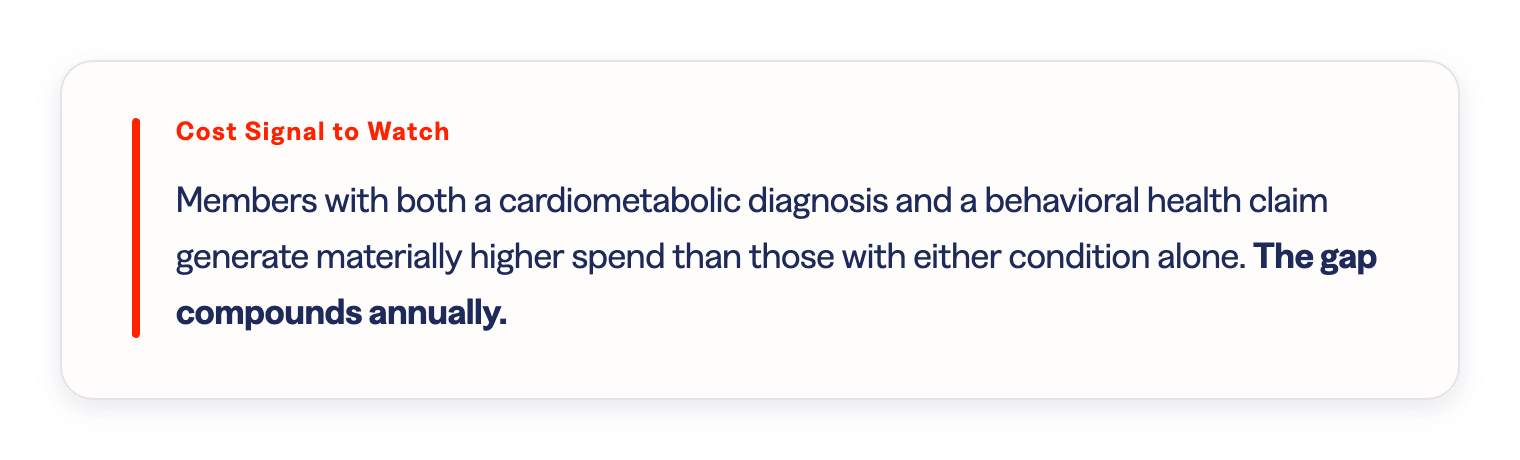
This is the most well-documented comorbidity cluster in chronic disease management. Type 2 diabetes and hypertension co-occur at high rates, sharing upstream metabolic risk factors. What is less consistently addressed is the behavioral health dimension.
Adults with type 2 diabetes are two to three times more likely to experience depression than the general population. Depression, in turn, is associated with lower medication adherence, higher A1C levels, and increased emergency utilization. Hypertension follows a similar pattern: untreated anxiety and chronic stress are independent contributors to elevated blood pressure, and members managing both conditions without behavioral health support show worse cardiovascular outcomes.
A benefits strategy that addresses diabetes and hypertension through clinical programs while routing behavioral health to a separate EAP or standalone mental health app is not managing this cluster. It is managing two of its three components and leaving the most behaviorally modifiable one on the table.
- Cluster 2: Weight Management, MSK, and Behavioral Health
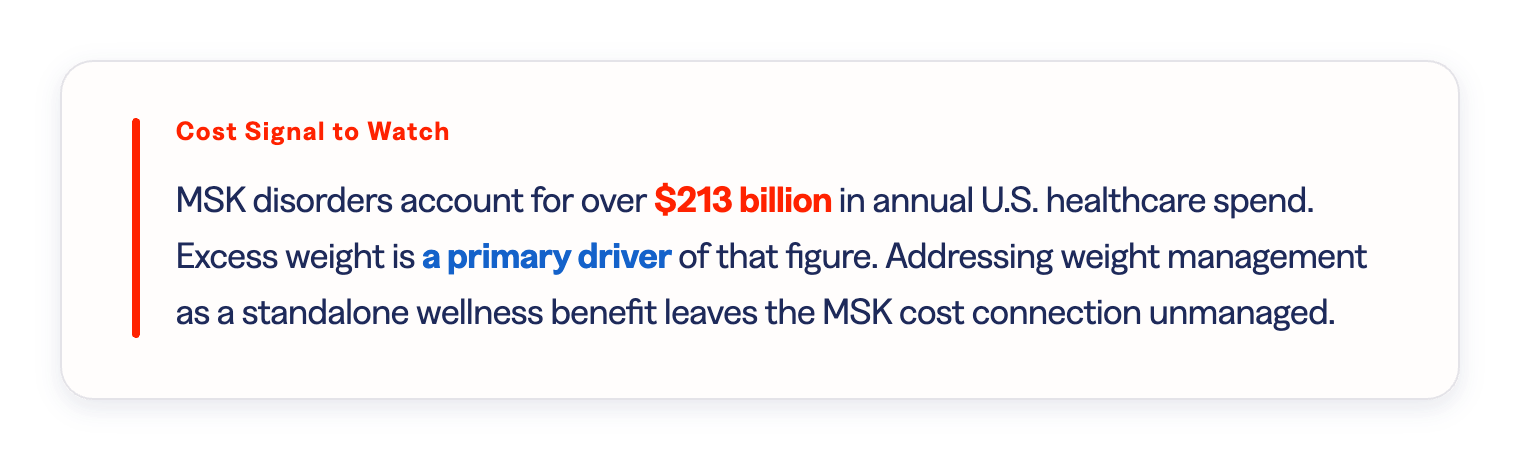
Excess body weight is the primary modifiable risk factor for the two most expensive categories in most employer claims portfolios: musculoskeletal disorders and behavioral health conditions.
The MSK connection is mechanical and well-established: excess weight accelerates joint degeneration, increases lumbar spine load, and significantly raises the risk of knee and hip replacement surgery. A member who achieves and sustains clinically meaningful weight loss generates fewer orthopedic claims. That is not a wellness outcome. That is a surgical avoidance outcome.
The behavioral health connection is equally significant but less operationally addressed. Depression and anxiety are both risk factors for weight gain and consequences of obesity, creating a reinforcing cycle that neither a weight management program nor a behavioral health program can fully interrupt in isolation.
Members in this cluster who receive integrated support for weight management and behavioral health simultaneously show meaningfully better engagement and outcomes than those receiving either intervention alone. Point solutions, by design, cannot deliver that integration.
- Cluster 3: MSK and Behavioral Health
Chronic pain is one of the least-discussed behavioral health drivers in employer benefits strategy. It is also one of the most consequential.
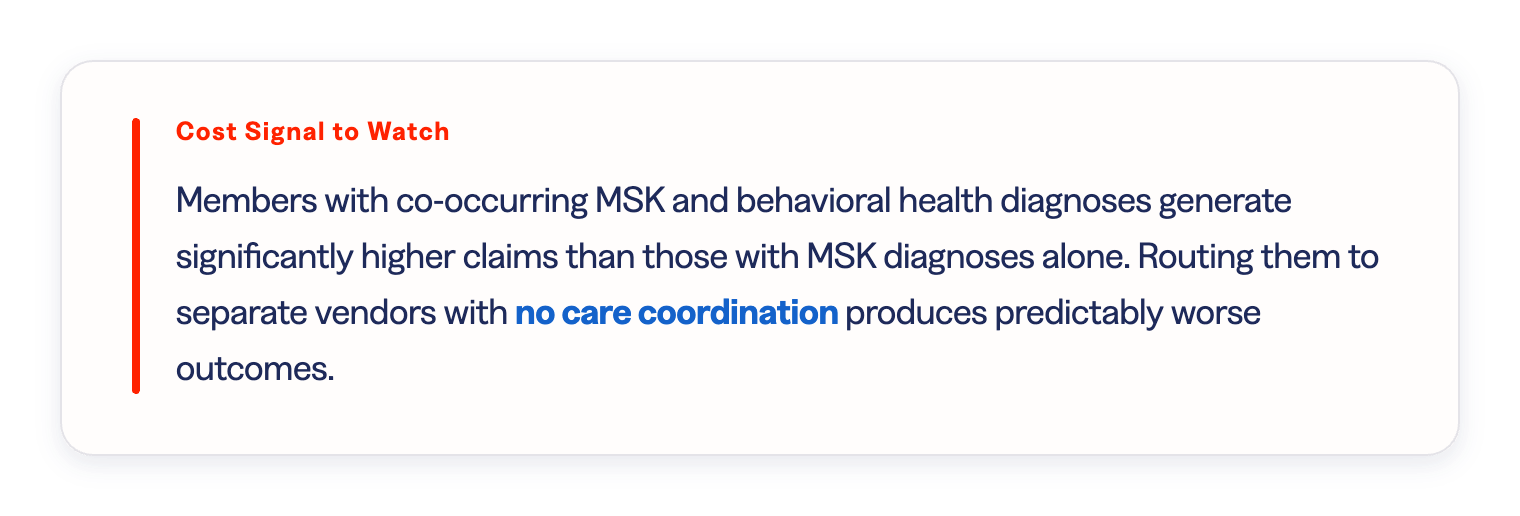
Adults managing chronic musculoskeletal conditions, back pain, osteoarthritis, repetitive stress injuries, experience depression and anxiety at rates significantly higher than the general population. The relationship is bidirectional: depression lowers pain tolerance, reduces physical activity, and impairs rehabilitation engagement. Untreated behavioral health conditions in members with MSK diagnoses are associated with longer recovery timelines, higher surgical rates, and increased opioid-related risk.
This cluster is particularly relevant for large employer populations with significant physical labor components or desk-work sedentary risk. In both cases, MSK conditions present early and, without integrated behavioral health support, progress faster and cost more.
What integration actually looks like in practice
Operationalizing whole-person health means moving from a roster of point solutions to a model that can identify comorbid members, match them to programs that address their full clinical profile, and measure outcomes across conditions, not just within them.
That requires three things most siloed benefits architectures cannot currently deliver:
- First, shared data visibility. If a member's diabetes program vendor cannot see their behavioral health utilization, and vice versa, there is no integration. There is coordination theater.
- Second, risk stratification that operates at the cluster level. Identifying a member as high-risk for diabetes is useful. Identifying a member as high-risk for the diabetes-hypertension-behavioral health cluster, and routing them to a program model that addresses all three, is actionable.
- Third, outcome measurement that crosses condition boundaries. If your reporting shows A1C improvement but cannot connect it to behavioral health utilization change or MSK claim reduction, you are measuring program performance, not population health improvement.
Benefits leaders who build this capability stop purchasing point solutions and start purchasing integrated population management. The distinction shows up in both outcomes and cost trend.
The frame shift that makes whole-person health financeable
Whole-person health becomes a strategic priority, not a wellness initiative, when it is defined as comorbidity management and measured through claims outcomes rather than engagement metrics.
The three clusters above are a starting point, not an exhaustive list. Your population has its own cost drivers, its own comorbidity patterns, and its own intervention opportunities. The question for benefits leaders is not whether whole-person health is a good idea. It is whether your current benefits architecture is designed to find those clusters, intercept them early, and measure what changes when you do.
If the honest answer is no, that is the operational definition of the problem.
See what your population's comorbidity clusters are costing you.
Solera Health uses predictive claims analysis to identify the comorbidity patterns driving cost in your population and match members to evidence-based digital health programs designed to address their full clinical profile, not just their presenting diagnosis.
Explore Other Resources
6/1/2026

The Network Effect: Proving the Value of Curated Digital Health
$1,241 — Total cost of care reduction per member
5/15/2026
Employer Health Care Costs in 2026: What’s Driving the Spike and What’s Actually Working
Do Digital Health Programs Reduce Employer Health Care Costs?
4/6/2026
Death By a Thousand Vendors: A Study of 106 Senior Benefits Leaders
More vendors. More spend. More headcount. And yet — the problem is getting worse.

.png)
