


1/1/2026
Why Diabetes Cannot Be Managed Without Also Managing Depression
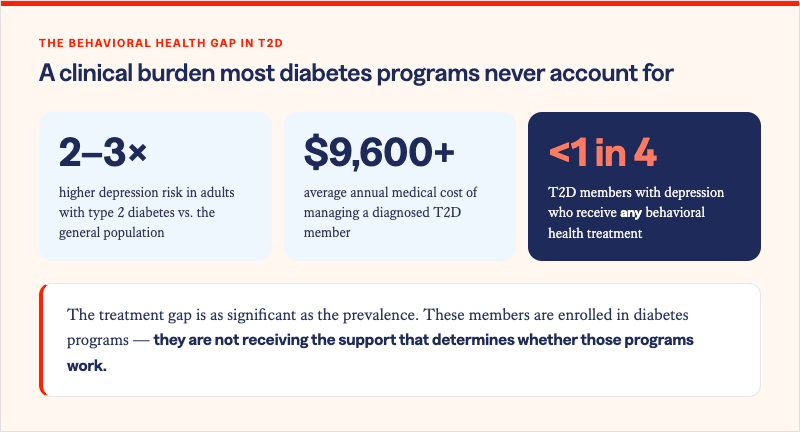
Adults with type 2 diabetes are two to three times more likely to experience depression than the general population. That statistic does not appear in most diabetes program vendor proposals. It should be the first line.
A diabetes management program that does not account for this reality is not delivering the A1C outcomes the evidence promises. It is delivering A1C outcomes for a healthier population than the one enrolled in your plan -- a population without the clinical burden of untreated depression impairing every behavioral lever the program depends on.
For benefits leaders evaluating standalone diabetes point solutions, the behavioral health gap is not a secondary consideration. It is a primary reason those programs underperform against their own benchmarks in real-world employer populations.
The elevated depression risk in T2D populations is not incidental
The relationship between type 2 diabetes and depression is bidirectional and self-reinforcing. Depression is both a risk factor for T2D onset and a consequence of living with the diagnosis. The physiological mechanisms run in both directions simultaneously.
On the diabetes-to-depression pathway: chronic hyperglycemia produces systemic inflammation, and inflammatory cytokines cross the blood-brain barrier and disrupt neurotransmitter function. Insulin resistance, which underlies T2D in most members, is independently associated with depressive symptoms. The psychological burden of managing a chronic condition, monitoring blood glucose, adhering to dietary restrictions, navigating medication regimens, and absorbing the long-term prognosis, compounds the biological risk.
On the depression-to-diabetes pathway: depression drives weight gain through disrupted metabolic hormones, reduces physical activity through fatigue and anhedonia, and impairs the executive function required to sustain the self-management behaviors that diabetes control depends on. A member who develops depression before a T2D diagnosis is at meaningfully elevated risk of developing T2D. A member who develops depression after a T2D diagnosis is at elevated risk of losing glycemic control.
How depression undermines every lever in a diabetes management program
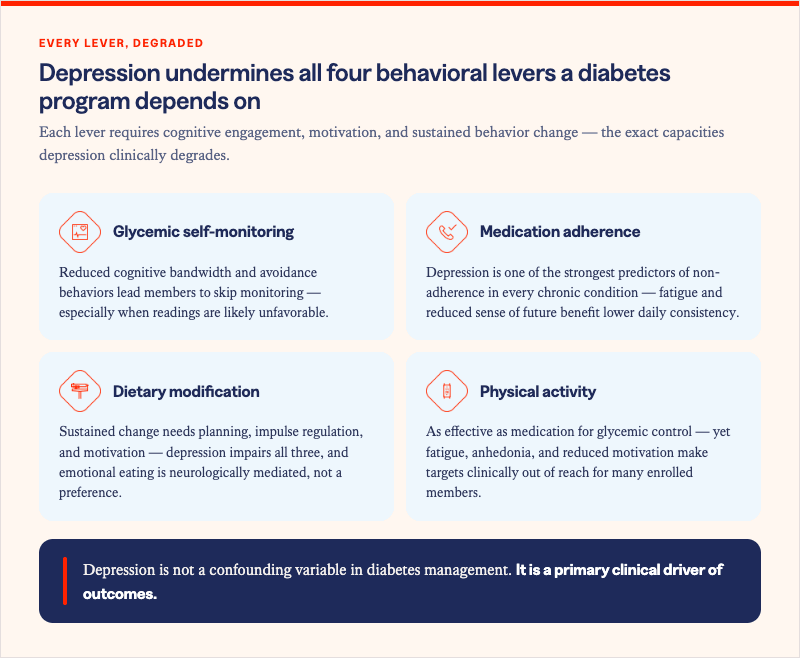
Standard diabetes management programs are built around a set of behavioral levers: glycemic self-monitoring, medication adherence, dietary modification, and physical activity. Each of these levers requires cognitive engagement, consistent motivation, and the capacity to sustain behavior change over time. Depression clinically degrades all of them.
- Glycemic self-monitoring. Blood glucose monitoring requires daily attention, accurate recording, and willingness to act on readings. Depression reduces cognitive bandwidth, impairs attention to routine tasks, and is associated with avoidance behaviors that lead members to skip monitoring when readings are likely to be unfavorable. A member with untreated depression enrolled in a diabetes management program will have lower monitoring adherence than the program's outcomes data assumes.
- Medication adherence. Antidiabetic medications require consistent daily administration. Depression is one of the strongest predictors of medication non-adherence across all chronic conditions. The combination of fatigue, cognitive impairment, and the reduced sense of future benefit associated with depression produces adherence rates in diabetic members with untreated depression that are materially lower than in members without comorbid behavioral health burden.
- Dietary modification. Sustained dietary change requires planning, impulse regulation, and the motivational capacity to prioritize long-term health outcomes over immediate behavioral rewards. Depression impairs all three. Emotional eating as a coping mechanism is neurologically mediated, not a preference. A diabetes program that provides nutritional guidance without addressing the behavioral health barriers to following it is providing information to a member who cannot act on it.
- Physical activity. Exercise is one of the most effective glycemic control interventions available, with documented A1C reduction effects that approach those of pharmacological management. Depression directly reduces physical activity through fatigue, anhedonia, and reduced motivation. A diabetes program that sets physical activity targets without integrated behavioral health support is setting targets that a significant share of enrolled members are clinically incapable of meeting.
What a structurally complete diabetes program looks like
A diabetes management program that is designed for the real-world population it serves includes three elements that most standalone point solutions do not currently deliver.
- Behavioral health screening at intake. Every member enrolling in a diabetes management program should be screened for depression and anxiety before their care plan is established. A member who screens positive for depression requires a different program intensity, a different coaching approach, and potentially a different clinical resource mix than a member who does not. Screening after poor outcomes are already accumulating is not clinical integration. It is reactive triage.
- Integrated behavioral health support within the program. Routing a member who screens positive to a separate EAP or mental health benefit does not constitute integration. It introduces friction at the exact moment when engagement is most fragile. Behavioral health support should be delivered within the diabetes program, by a coordinated clinical team, with shared outcome measurement that tracks both A1C and depression symptom burden over time.
- Outcome measurement that crosses condition boundaries. A diabetes program that reports A1C improvement without connecting it to behavioral health utilization change is not measuring what determines whether that improvement is sustained. The members whose A1C improves on program and then deteriorates at 12 months are, disproportionately, the members with unaddressed depression. Tracking that pattern is how a program improves. Ignoring it is how a program flatlines.
Solera Health's network addresses Diabetes and Behavioral Health as connected condition areas, with evidence-based digital programs matched to members based on their full clinical profile. The Precision Insights Suite identifies members carrying both metabolic and behavioral health risk using predictive claims modeling. The HALO Platform connects those members to programs designed for clinical complexity, with outcomes tracked across condition boundaries through medical claims.
A diabetes program without behavioral health integration is not a complete diabetes program. It is a partial one, measured against benchmarks generated in populations healthier than yours.
Solera Health connects benefits leaders and health plan executives to evidence-based digital health programs spanning Diabetes and Behavioral Health, matched to member clinical profiles and measured through medical claims outcomes.
Explore Other Resources
6/1/2026

The Network Effect: Proving the Value of Curated Digital Health
$1,241 — Total cost of care reduction per member
5/15/2026
Employer Health Care Costs in 2026: What’s Driving the Spike and What’s Actually Working
Do Digital Health Programs Reduce Employer Health Care Costs?
4/6/2026
Death By a Thousand Vendors: A Study of 106 Senior Benefits Leaders
More vendors. More spend. More headcount. And yet — the problem is getting worse.

.png)
